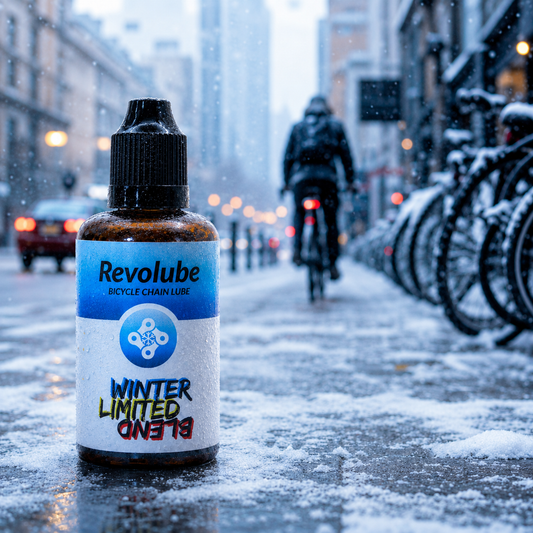
How to choose the right chain lubricant?
Choosing the right bicycle chain lube can seem complicated — but it really doesn’t have to be. In this article, we explain the most common types of chain lubricants, how they work in real-world riding, and how to match the right formula to your conditions. No myths, no marketing traps — just a bit of humour and solid technical insight.
Why is chain lubrication so important?
A bicycle chain operates under extreme conditions: metal-on-metal contact, high loads, and constant exposure to moisture, dirt, and road salt. A properly selected lubricant:
- reduces friction,
- quietens the drivetrain,
- protects against corrosion,
- significantly extends component lifespan.
In short: the right lube is an investment that pays off.
Types of bicycle chain lubricants – overview and real-world use
Below you’ll find a structured overview of the most common lubricant types on the market, along with practical guidance.
1. “Wet” lubricants – best for rain and mud
Wet lubes are thick, oil-based formulations that adhere strongly to metal surfaces. Thanks to these properties, they offer excellent resistance to wash-off.
Pros:
- strong corrosion protection,
- durability in harsh conditions,
- ideal for wet rides.
Cons:
- attract dirt,
- require more frequent drivetrain cleaning.
Best for: Road, MTB, gravel, winter riding, rainy commuting.
2. “Dry” lubricants – a clean drivetrain for dry days
Dry lubes work differently: after application, the carrier evaporates, leaving behind a thin, dry protective layer that resists dust — but not water.
Pros:
- clean drivetrain,
- low dirt attraction,
- excellent for summer riding.
Cons:
- poor resistance to rain,
- more carrier than actual lubricant in the bottle,
- wear off quickly in wet conditions.
3. Chain waxes – precision and cleanliness
Wax-based lubricants have grown in popularity year after year — and for good reason. After application (often as an emulsion or hot-wax), the chain remains exceptionally clean and friction is very low. Waxing does require meticulous preparation and additional equipment such as stands or heaters, but it delivers the highest level of drivetrain cleanliness.
Pros:
- very low friction,
- clean and quiet drivetrain operation,
- high durability.
Cons:
- requires a perfectly clean chain,
- application can be fiddly,
- needs additional equipment.
4. Ceramic lubricants – premium technology
Ceramic lubes claim reduced friction thanks to ceramic nanoparticles. Some do deliver excellent results, but for everyday riders the difference can be marginal. Cynics like to joke that “ceramic lube” is just abrasive paste in disguise.
Pros:
- often smooth and quiet operation,
- sometimes longer-lasting than traditional oils.
Cons:
- higher price,
- performance depends on the full formulation, not just the word “ceramic”.
5. “All-weather” lubricants – a universal solution
For riders who don’t want to check the forecast before every ride, all-weather lubes offer a convenient compromise.
Pros:
- reliable performance in most conditions,
- no need to own multiple lubricants,
- a sensible balance between cleanliness and durability.
Cons:
- not the absolute best in extreme wet or extreme dry conditions.
6. PTFE (Teflon) lubricants – smooth running without complexity
PTFE, better known as Teflon, is an extremely low-friction material used in many lubricants. However, some analyses suggest that PTFE additives may have a limited real-world impact, and are often more of a marketing label than a performance breakthrough.
Pros:
- smooth and quiet operation,
- good water resistance,
- a solid compromise for many riders.
Cons:
- actual performance depends on the full formulation,
- sometimes overused in marketing.
7. Graphene lubricants – race-level performance
Graphene is a single-atom-thick layer of carbon — incredibly strong and extremely slippery. Lubricants containing graphene are among the most advanced on the market.
Pros:
- extremely low friction,
- clean drivetrain operation,
- very long service intervals.
Cons:
- high price,
- require perfectly clean chains,
- perform best in dry conditions.
8. MACSC lubricants (Modified Active Calcium Sulphonate Complex) – industrial-grade resilience
Less commonly discussed in mainstream cycling guides, lubricants based on Modified Active Calcium Sulphonate Complex stand out thanks to their industrial heritage and exceptional durability.
This technology has been used for years in heavy machinery, where reliability and resistance to extreme loads matter more than marketing buzzwords.
What sets them apart?
-
Chemical bonding with metal
Rather than just forming a surface film, MACSC can react with metal surfaces to create a stable, highly durable protective layer. -
High load resistance
Excellent performance under heavy loads — important for e-bikes, MTB, and year-round riding. -
Outstanding water and corrosion resistance
Sulphonate complexes naturally resist water, road salt, and chemical degradation. -
Long-lasting protective layer
The protective film remains on the chain longer than with many conventional oil-based lubricants.
Who are they for?
For riders looking for a stable, durable lubricant that performs across a wide range of conditions, without the need for complex application processes (as with waxes or graphene).
How to choose a chain lubricant? A simple decision map
Choosing the right lube is easy when you match it to your riding conditions.
Dry conditions
Choose: Dry, Wax, Graphene, MACSC
Priority: cleanliness, low friction.
Rainy or winter riding
Choose: Wet, All-weather, MACSC
Priority: water resistance, metal protection.
Urban and daily riding
Choose: All-weather, PTFE, MACSC
Priority: convenience, durability.
Sport riding, racing, power loss minimisation
Choose: Wax, Graphene, MACSC
Priority: maximum efficiency.
Minimum maintenance
Choose: Wet, All-weather, MACSC
Priority: stability and simple application.
The most common mistake – lubricating a dirty chain
Lube applied to dirt doesn’t lubricate — it works like grinding paste. Always remember: clean first, then lubricate.
Summary
There is no single perfect lubricant for everyone, but there is a perfect lubricant for your riding style:
- Wet — rain, mud, winter.
- Dry / Wax — clean, dry routes.
- All-weather — versatility.
- PTFE — smoothness and simplicity.
- Graphene — premium performance.
- MACSC — durability and resilience across conditions.
A good lubricant means longer drivetrain life, smoother operation, and more enjoyable riding.